News

Click on the buttons below to see the latest news released by SecondStreet.org, blog posts, and news media coverage of SecondStreet.org’s work.

July 17, 2025
SecondStreet.org Policy Director Bacchus Barua writes in The Financial Post that more choice in health care could help senior citizens.
July 9, 2025
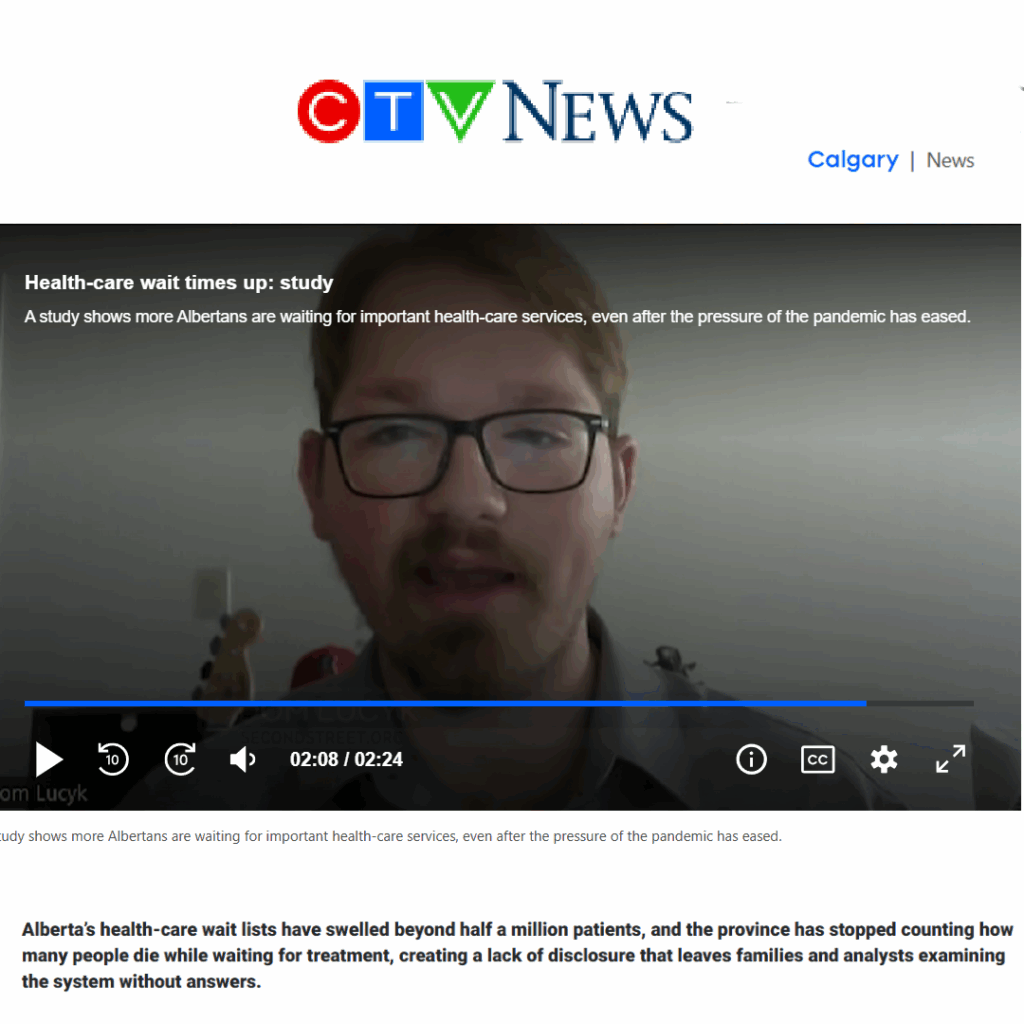
SecondStreet.org Communications Director Dom Lucyk joined Jim Csek to discuss waiting list deaths in Kelowna and the surrounding area.
July 8, 2025
New SecondStreet.org research shows that waitlist deaths are on the rise in an area of B.C.
June 9, 2025
Colin welcomes Morrigan Geleynse and Jonathan Barazzutti to discuss their award winning essays.
May 29, 2025
SecondStreet.org Communications Director Dom Lucyk joined Mike Smyth to discuss health reform in B.C. and the rest of Canada.
May 28, 2025
SecondStreet.org interviewed Lorne Johnson, a Canadian cancer patient who travelled to the U.S. for life-saving surgey.
May 24, 2025
SecondStreet.org President Colin Craig writes in The Hub that Canada can change the Canada Health Act to allow for choice in health care.
May 21, 2025
SecondStreet.org Legislative and Policy Director Harrison Fleming joined Evan Bray to discuss health care reform in Manitoba and Alberta.
May 21, 2025
SecondStreet.org interviewed Bruce, a Manitoba man who travelled to the U.S. for life-saving surgey.
May 20, 2025
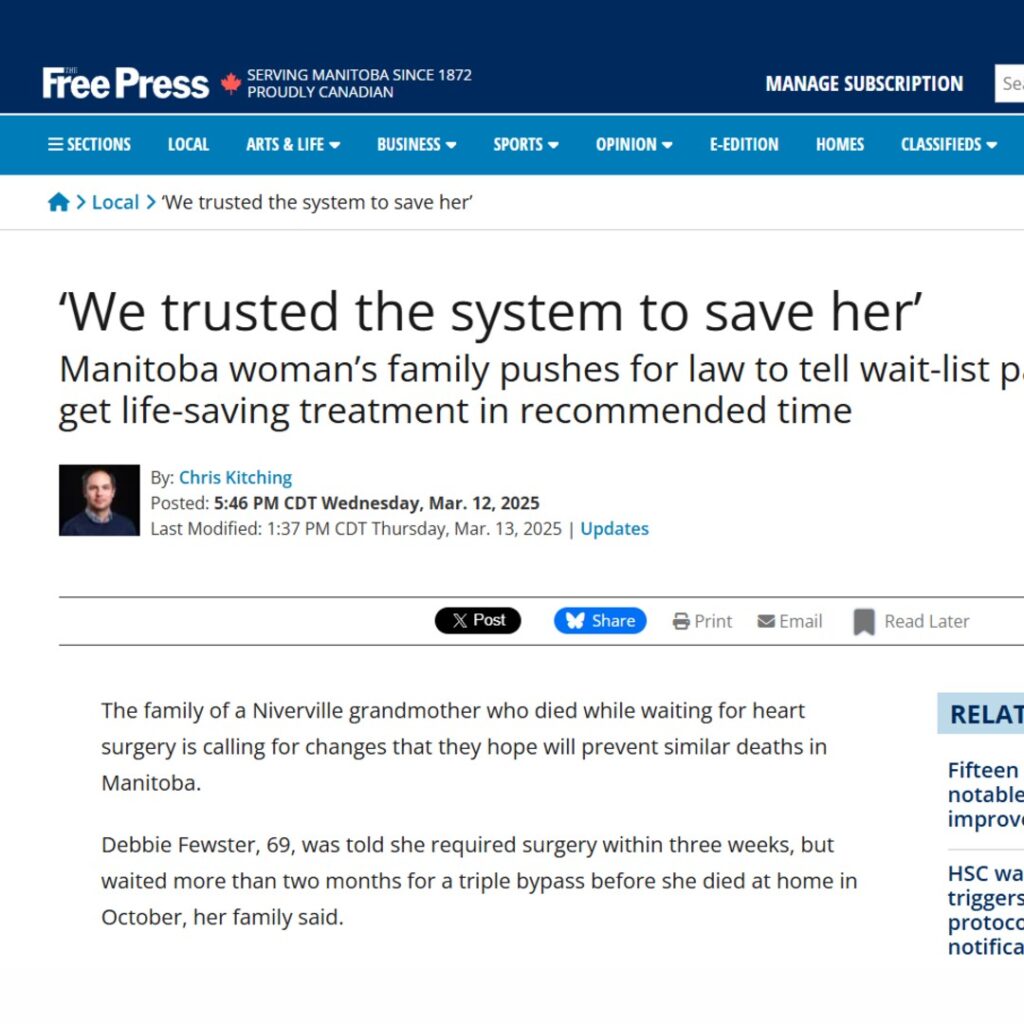
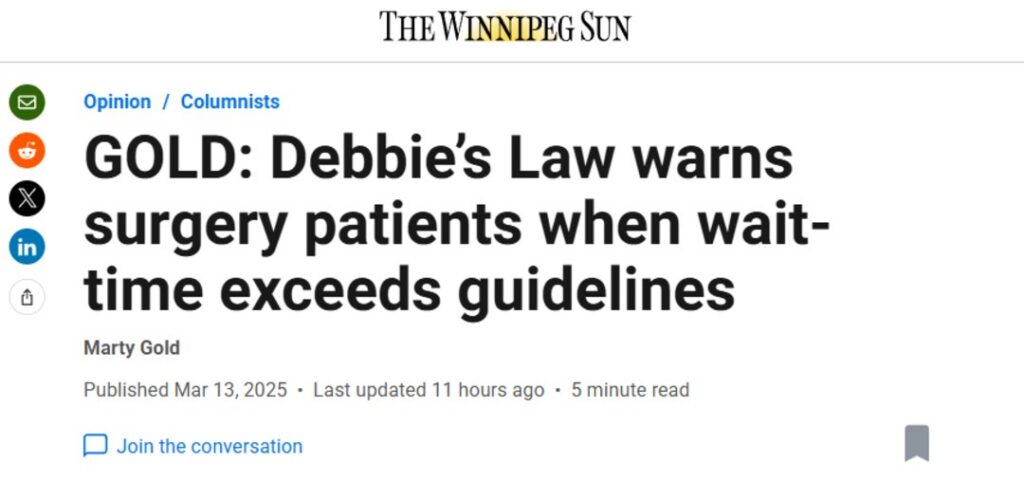
SecondStreet.org President Colin Craig writes in The Financial Post that Debbie's Law is an easy way to save lives and improve accountability in health care.
May 19, 2025
Colin welcomes Dan Breznitz and Ian Lee to discuss how Canada can move the economy forward .
May 14, 2025
A new SecondStreet.org report examines the changes needed to the Canada Health Act to allow patients to pay for private health care.
May 12, 2025
Colin welcomes Paige Macpherson and Jonah Davids to discuss mental health in relation to smartphones and social media.
May 6, 2025
SecondStreet.org President Colin Craig writes in The Winnipeg Free Press that Debbie's Law is an easy way to save lives and improve accountability in health care.
May 5, 2025
Colin welcomes Bob Lamondon and Tristin Hopper to discuss their books on Canadian public policy.
April 24, 2025
SecondStreet.org travelled to Lithuania with Manitoba patient Aaron Strub, who received hip surgery in the Baltic country.
April 23, 2025
CTV News Winnipeg covered the political response to a new SecondStreet.org policy proposal: Debbie's Law.
April 23, 2025
Global News Winnipeg covered the political response to a new SecondStreet.org policy proposal: Debbie's Law.
April 23, 2025
CityNews Winnipeg covered the political response to a new SecondStreet.org policy proposal: Debbie's Law.
March 20, 2019
This past December, Kris Sims from the Canadian Taxpayers Federation and I drove from Burnaby, B.C. just over the border to a hospital complex in Bellingham (Washington State). We were hoping to talk to Canadians about why they were leaving the country for health care...
March 19, 2019
Patients should note that the B.C. government and the Canada Health Act have two very different definitions of "extra-billing."
March 2, 2019
Big thank you to CKNW’s Lynda Steele for having SecondStreet.org on her show this week to talk about our new health care video...
March 2, 2019
Here’s an interesting story from the New Brunswick wing of the CBC.
February 23, 2019
Over the past few months we’ve been doing lots of health care research and have come across a few interesting stories about health care in “communist” China.
February 22, 2019
We noticed a couple examples of how Ottawa is sending mixed signals when it comes to private health care in Canada.
February 22, 2019
CEO Troy Lanigan discusses the story behind SecondStreet.org
January 27, 2025
Colin welcomes guests Scott Fash and Jay Goldberg to discuss the housing crisis in Canada.
January 22, 2025
Colin welcomes Felix Hosse and Olesyas Shyvikova to discuss different aspects of the Russia/Ukraine war 3 years later.
January 21, 2025
SecondStreet.org Communications Director Dom Lucyk joined Phil Johnson to discuss the latest data on health care waitlist deaths in Canada.
January 20, 2025
SecondStreet.org's Harrison Fleming joined CBC Vancouver to discuss the latest numbers on waitlist deaths in Canada.
January 16, 2025
SecondStreet.org President Colin Craig joined Ben O'Hara-Byrne to discuss the latest data on health care waitlist deaths in Canada.
January 16, 2025
The National Post covered a new SecondStreet.org report showing the latest numbers of health care waitlist deaths in Canada.
January 15, 2025
SecondStreet.org President Colin Craig joined Marc Patrone to discuss the latest data on health care waitlist deaths in Canada.
January 15, 2025
The Toronto Sun covered a new SecondStreet.org report showing the latest numbers of health care waitlist deaths in Canada.
January 4, 2025
SecondStreet.org President Colin Craig writes in the Calgary Herald that Alberta Health has taken a step back in transparency on health care data.
December 27, 2024
Colin speaks with Matthew Lau and Renaud Brossard to discuss the best and worst of government policy in 2024.
December 23, 2024
Colin speaks with Harrison Fleming and Emmanuelle Faubert to discuss Canadian patients dying while on waitlists.
December 16, 2024
Colin speaks with Sabine El-Chidiac to discuss Canada's cost of living issue and what policy changes Canada can implement to make life more affordable.
December 12, 2024
The National Post covered new SecondStreet.org data that shows an Ontario hospital continues to dump money down the drain running a failing coffee shop.
December 9, 2024
Colin speaks with Dom Lucyk and Shawn Whatley to discuss Canadians' views on health reform.
December 7, 2024
SecondStreet.org Communications Director Dom Lucyk writes in the Toronto Sun that Canadians are sick of Soviet-style health care.
December 3, 2024
Colin speaks with David Long and Wendy Quarrington to discuss the growing demand on Canada's food banks.
November 29, 2024
SecondStreet.org Communications Director Dom Lucyk writes in the Regina Leader-Post that Saskatchewan's re-elected government must make bold changes to health care.
November 25, 2024
Colin is joined by Dr. Paula Gordon and Leah Rowntree to discuss breast cancer prevention and treatment.
November 19, 2024
SecondStreet.org Communications Director Dom Lucyk joined CTV Morning Live Regina to discuss the latest numbers on waitlist deaths in Saskatchewan.
November 18, 2024
Colin is joined by Colonel Gary Solar, MSM, CD, to discuss the Canadian World War II hero, Sir William Stephenson.
March 2, 2023
SecondStreet.org has released newly obtained data from Manitoba, Ontario and Alberta on patients who died on a waiting list in 2021-22.
February 16, 2023
New data obtained by SecondStreet.org shows that the hospital-run Tim Horton's at Windsor Regional Hospital continues to lose money.
January 30, 2023
The latest government data obtained by SecondStreet.org shows that 3.2 million Canadians are waiting for surgery, a diagnostic scan, or to see a specialist
January 25, 2023
Government data obtained by SecondStreet.org shows that 343 Saskatchewan patients died while waiting for surgery in 2021-22, a 23% increase over the previous year
January 16, 2023
SecondStreet.org is responding to the Ontario government's decision to partner with more private clinics to help reduce the surgical backlog.
December 19, 2022
In November 2022, SecondStreet.org hired Leger to poll Canadians on health care. Here are the results ...
December 13, 2022
SecondStreet.org has released its annual Died on a Waiting List report. We filed Freedom of Information requests with provincial governments to find out how many people died while waiting for a surgery or diagnostic scan. Unfortunately, the sad trend of more people dying on a waitlist continued this year.
December 13, 2022
SecondStreet.org has released its annual Died on a Waiting List report for 2021-22. Once again, a troubling trend continues: more people are dying while waiting for surgery or diagnostic scans.
November 9, 2022
SecondStreet.org has released data obtained from provincial governments that shows at least 2.9 million Canadians are on waitlists for surgery, diagnostics, or to see a medical specialist.
November 5, 2022
The prairie province launched its well-known "Saskatchewan Surgical Initiative" back in 2010 to reduce their waiting lists – some of the highest in the country at the time. To learn more about this initiative we reached out to the Saskatchewan government for an interview. They declined our request, but they did answer our questions in an email.
October 25, 2022
A new poll commissioned by think tank SecondStreet.org shows that Canadians continue to show overwhelming support for health reform, including governments hiring private clinics to reduce surgical backlogs, allowing more choices for patients, copying an EU policy and increased accountability when it comes to patient deaths due to long waiting lists.
October 25, 2022
A new SecondStreet.org poll shows that Canadians are keen for health reform. We hired Leger to ask Canadians about four different reform options. The majority of respondents were in favour of each option.
August 18, 2022
SecondStreet.org recently wrote to Ontario's Minister of Health to seek additional details on patients dying on waiting lists in the province.
August 15, 2022
New Ontario Health data released by SecondStreet.org shows a spike in the number of patients that died while waiting for surgery, CT scans and MRI scans in 2021-22.
July 19, 2022
This policy brief examines the EU's cross border directive – a policy that reimburses patients when they pay for surgery in other EU countries.
July 19, 2022
Think tank SecondStreet.org released a new report that examines a health care policy in Europe that could help address Canada’s waiting list crisis immediately.
March 28, 2022
SecondStreet.org sat down with Sharon Kilkenny - a patient who faced a 93 week waiting list for hip surgery while she lived in chronic pain.
March 23, 2022
SecondStreet.org speaks with Jessica Bailey from Saskatoon about the effects of the government cancelling her transplant surgery because of the pandemic.
March 9, 2022
SecondStreet.org spoke with Wendy Petersen from Manitoba about her long wait for knee replacement surgery in Canada.
February 28, 2022
We speak with Chris Vander Doelen from Harrow, Ontario about how his trip to Los Angeles saved his life from prostate cancer.

We want to hear
your story!

Whether your experience with healthcare or education was a success or a struggle, your story is vital. We amplify the real-life experiences of Canadians to show what’s working and what’s failing.

Join 20,000+ Canadians in our movement for a better Canada.

Name(Required)
Select Your Interests(Required)
Consent(Required)

Prevention – reduce demand in the first place

If Canadians lived healthier lives, we could reduce demand for emergency services, orthopaedic surgeries, primary care and more. 

For instance, if you visit the Canadian Cancer Society’s website, you’ll read that “about four in ten” cancer cases are preventable. The Heart and Stroke Foundation notes that “almost 80 percent of premature heart disease and stroke can be prevented through healthy behaviours.” A similar number of Diabetes cases are also preventable. 

Many joint replacements and visits to ERs and walk-in clinics could also be avoided through healthy living. 

To be sure, not all health problems can be avoided through healthy living – everyday the system treats Canadians with genetic conditions, helps those injured in unavoidable accidents and more.  

But there is an opportunity to reduce pressure on the health care system through Canadians shifting to healthier lifestyles – better diets, more exercise, etc. 

To learn more, watch our Health Reform Now documentary (scroll up) or see this column. 

Partner with non-profits and for-profit clinics

European countries will partner with anyone who can help patients. 

It doesn’t matter if it’s a non-profit, a government entity or a private clinic. What matters is that patients receive quality treatment, in a timely manner and for a competitive price.  

In Canada, governments often delivery services using government-run hospitals instead of seeing if non-profit or private clinics could deliver the services more effectively. 

When governments have partnered with non-profit and private clinics, the results have often been quite good – Saskatchewan, Ontario and British Columbia are just a few examples of where partnerships have worked well. 

Canada should pursue more of these partnerships to reduce wait times and increase the volume of services provided to patients.  

To learn more, watch our Health Reform Now documentary (scroll up) or see the links above. 

Make cross border care more accessible

In Canada, citizens pay high taxes each year and we’re promised universal health care services in return. The problem is, wait times are often extremely long in our health system – sometimes patients have to wait years to see a specialist or receive surgery. 

If patients don’t want to wait long periods, they often have to reach into their own pocket and pay for treatment outside the province or country. 

Throughout the European Union, we also find universal health care systems. But a key difference is that EU patients have the right to go to other EU countries, pay for surgery and then be reimbursed by their home government. Reimbursements cover up to what the patient’s home government would have spent to provide the treatment locally. 

If Canada copied this approach, a patient waiting a year to get their hip operation could instead receive treatment next week in one of thousands of surgical clinics throughout the developed world. 

Governments benefit too as the patient is now back on their feet and avoiding complications that sometimes come with long wait times – meaning the government doesn’t have to treat those complications on top of the initial health problem. 

To learn more, watch our Health Reform Now documentary (scroll up) or this shorter video. 

Legalize access to non-government providers

Canada is the only country in the world that puts up barriers, or outright bans patients from paying for health services locally. 

For instance, a patient in Toronto cannot pay for a hip operation at a private clinic in Toronto. Their only option is to wait for the government to eventually provide treatment or leave the province and pay elsewhere. 

Countries with better-performing universal health care systems do not have such bans. They allow patients a choice – use the public system or pay privately for treatment. Sweden, France, Australia and more – they all allow choice. 

Why? One reason is that allowing choice means some patients will decide to pay privately. This takes pressure off the public system. For instance, in Sweden, 87% of patients use the public system, but 13% purchase private health insurance. 

Ultimately, more choice improves access for patients. 

To learn more, watch our Health Reform Now documentary (scroll up) or watch this short clip on this topic. 

Shift to funding services for patients, not bureaucracies

In Canada, most hospitals receive a cheque from the government each year and are then asked to do their best to help patients. This approach is known as “block funding”. 

Under this model, a patient walking in the door represents a drain on the hospital’s budget. Over the course of a year, hospital administrators have to make sure the budget stretches out so services are rationed. This is why you might have to wait until next year or the year after for a hip operation, knee operation, etc. 

In better-performing universal health systems, they take the opposite approach – hospitals receive money from the government each time they help a patient. If a hospital completes a knee operation, it might receive, say, $10,000. If it completes a knee operation on another patient, it receives another $10,000. 

This model incentivizes hospitals to help more patients – to help more patients with knee operations, cataract surgery, etc. This approach also incentivizes hospitals to spend money on expenses that help patients (e.g. more doctors, nurses, equipment, etc.) rather than using the money on expenses that don’t help patients (e.g. more admin staff). 

To learn more about this policy option, please watch our Health Reform Now documentary (scroll up) or see this post by MEI.