


Free Online Townhall: How to Fix Health Care in Canada? Thursday, Sept 24 at 7pm ET.

Annual Died on a Waiting List Report Released

November 25, 2026

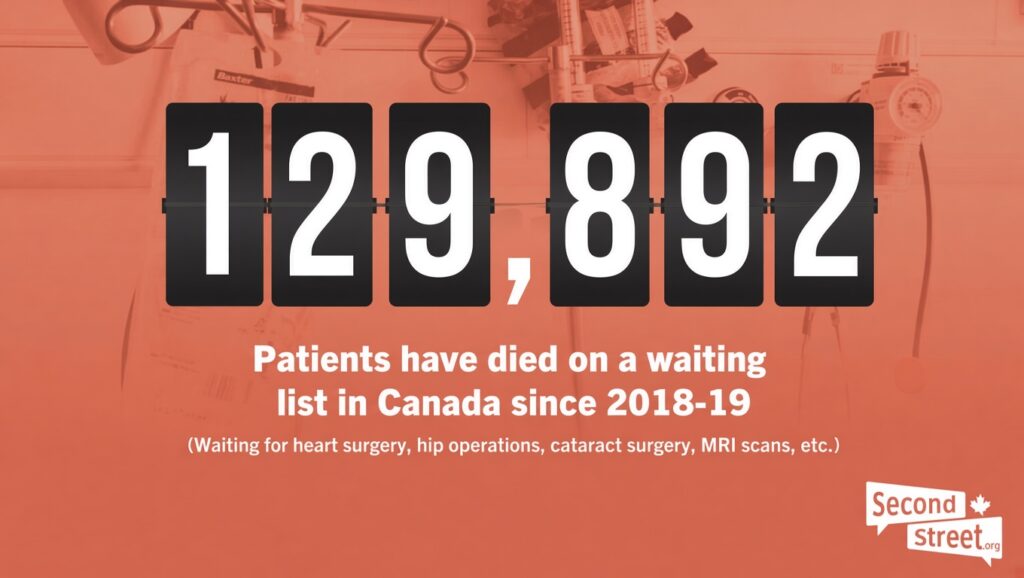
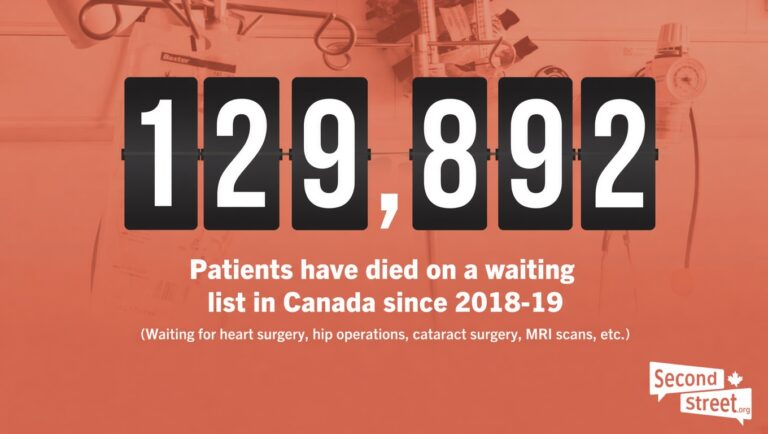
29,468 Canadians died on a waiting list last year. Nearly 130,000 have died waiting since 2018.

November 25, 2026

CALGARY, AB: Think tank SecondStreet.org released its latest Died on a Waiting List report today, showing that at least 29,468 cases were identified in 2025-26 where a surgery, procedure, diagnostic scan or specialist appointment was cancelled because the patient died. Since April 2018, more than 129,892 patients have died on waiting lists. 

“Governments will publicly report if a restaurant is missing a paper towel holder, but they don’t report how many patients die in the health system,” said SecondStreet.org President Colin Craig. “That double standard needs to end. At a minimum, governments should track, analyze and disclose waiting list deaths every year so we all know where the problems are.”

The waitlist deaths figures are underreported, as many health bodies do not track or disclose complete data. This past year we saw a 17.5% increase in surgical waiting list deaths and a 2.8% decrease in diagnostic scan waiting list deaths. Overall, comparing only the health bodies that provided data in both years shows a 1.4% increase.

The 29,468 cases included treatments that were potentially lifesaving (e.g. heart surgery) as well as quality-of-life procedures such as orthopaedic and cataract surgery. Some patients died after waiting less than a week, while others had been waiting years for surgery. 

Other findings highlighted in the report:

  • Manitoba’s surgical waiting list deaths nearly doubled, rising from 163 to 316;
  • British Columbia’s total dipped from 4,620 to 4,365;
  • Alberta provided data once again, including 52 cardiac waitlist deaths; 
  • Saskatchewan’s surgical waiting list deaths dropped from 333 to 317, while cancer-related cases rose from 86 to 111;
  • Ontario saw a decline in waitlist deaths, however, the government should review the 115 cancer surgeries that were cancelled due to patients dying before treatment.
  • A Leger poll commissioned by SecondStreet.org in October 2026 found 18% of Canadians know someone who died due to a long wait time in the health care system.

Note: The data released by provincial providers varies, so comparisons between provinces can be misleading. 

Possible policy solutions to this issue include having governments track, analyze and publicly report waiting list deaths each year, allowing policymakers to address problem areas. Further, governments could copy a number of policies in better-performing public health care systems in Europe to reduce waiting list deaths.

To read the full policy brief, click here.

To view the freedom of information requests from various provincial health authorities, see hyperlinks below:

Patient Deaths While Waiting for Surgeries, Procedures, Diagnostic Scans and Specialists (2025-26)

ProvinceSurgical / ProceduresDiagnostic / SpecialistTotal
British Columbia9003,4654,365
Interior Health2061,403 
Fraser Health2171,516 
Northern Health4313 
Island Health245268 
Coastal Health189265 
Alberta878–878
 Health Shared Services878– 
Saskatchewan317111428
 Ministry of Health317– 
Saskatchewan Cancer Agency–111 
Manitoba396–396
Prairie Mountain Health80– 
Shared Health316– 
Ontario1,2919,08510,376
Ontario Health1,2919,085 
Quebec1,8799,66911,548
CISSS Bass-Saint-Laurent*1191,877 
CISSS Centre-Sud-de-l’Ile-de-Montréal39298 
CISSS Chaudiere-Appalaches–459 
CISSS Outaouais7888 
CISSS Abitibi-Temiscamingue371,510 
Santé Québec Laurentides**967422 
CISSS l’Est-de-l’Ile-de-Montréal***187– 
CISSS Monteregie-Centre68– 
CISSS Monteregie-East1081,267 
CIUSSS Estrie-Centre Sherbrooke1623,748 
CHU de Quebec Université Laval114– 
New Brunswick91–91
New Brunswick Health91– 
Nova Scotia1761,0291,205
Nova Scotia Health Authority1761,029 
Prince Edward Island3178181
Health PEI3178 
Newfoundland & LabradorRefusedRefused–
NL Health ServicesRefusedRefused 
TOTAL5,93123,53729,468

* Follow-up specialist appointments removed from total.

** Excludes patients waiting to meet with a nutritionist, social worker, chaplain or physiotherapist. Also excludes follow-up appointments.

*** Total diagnostic, specialist appointments (not including follow-up), non-follow-up specialist appointments, respiratory tests and heart tests.

 -30-

Share this Story

Help spread the message and make real change by sharing this story with your network.

Facebook
X
Email

How You Can Take Action

Whether you donate, speak up, or share our work, every action strengthens the push for better policies in health care, education, and everyday life. When Canadians get involved, leaders pay attention—and real reform becomes possible.

Related Stories

November 25, 2026
29,468 Canadians died on a waiting list last year. Nearly 130,000 have died waiting since 2018.
November 23, 2026
Our latest report on health care write-offs nationally made headlines across the pond.
November 18, 2026
A new report shows that Canadians have spent over $500 million over the past half decade on providing health care for tourists.

Join 20,000+ Canadians in our movement for a better Canada.

Name(Required)
Select Your Interests(Required)
Consent(Required)

Prevention – reduce demand in the first place

If Canadians lived healthier lives, we could reduce demand for emergency services, orthopaedic surgeries, primary care and more. 

For instance, if you visit the Canadian Cancer Society’s website, you’ll read that “about four in ten” cancer cases are preventable. The Heart and Stroke Foundation notes that “almost 80 percent of premature heart disease and stroke can be prevented through healthy behaviours.” A similar number of Diabetes cases are also preventable. 

Many joint replacements and visits to ERs and walk-in clinics could also be avoided through healthy living. 

To be sure, not all health problems can be avoided through healthy living – everyday the system treats Canadians with genetic conditions, helps those injured in unavoidable accidents and more.  

But there is an opportunity to reduce pressure on the health care system through Canadians shifting to healthier lifestyles – better diets, more exercise, etc. 

To learn more, watch our Health Reform Now documentary (scroll up) or see this column. 

Partner with non-profits and for-profit clinics

European countries will partner with anyone who can help patients. 

It doesn’t matter if it’s a non-profit, a government entity or a private clinic. What matters is that patients receive quality treatment, in a timely manner and for a competitive price.  

In Canada, governments often delivery services using government-run hospitals instead of seeing if non-profit or private clinics could deliver the services more effectively. 

When governments have partnered with non-profit and private clinics, the results have often been quite good – Saskatchewan, Ontario and British Columbia are just a few examples of where partnerships have worked well. 

Canada should pursue more of these partnerships to reduce wait times and increase the volume of services provided to patients.  

To learn more, watch our Health Reform Now documentary (scroll up) or see the links above. 

Make cross border care more accessible

In Canada, citizens pay high taxes each year and we’re promised universal health care services in return. The problem is, wait times are often extremely long in our health system – sometimes patients have to wait years to see a specialist or receive surgery. 

If patients don’t want to wait long periods, they often have to reach into their own pocket and pay for treatment outside the province or country. 

Throughout the European Union, we also find universal health care systems. But a key difference is that EU patients have the right to go to other EU countries, pay for surgery and then be reimbursed by their home government. Reimbursements cover up to what the patient’s home government would have spent to provide the treatment locally. 

If Canada copied this approach, a patient waiting a year to get their hip operation could instead receive treatment next week in one of thousands of surgical clinics throughout the developed world. 

Governments benefit too as the patient is now back on their feet and avoiding complications that sometimes come with long wait times – meaning the government doesn’t have to treat those complications on top of the initial health problem. 

To learn more, watch our Health Reform Now documentary (scroll up) or this shorter video. 

Legalize access to non-government providers

Canada is the only country in the world that puts up barriers, or outright bans patients from paying for health services locally. 

For instance, a patient in Toronto cannot pay for a hip operation at a private clinic in Toronto. Their only option is to wait for the government to eventually provide treatment or leave the province and pay elsewhere. 

Countries with better-performing universal health care systems do not have such bans. They allow patients a choice – use the public system or pay privately for treatment. Sweden, France, Australia and more – they all allow choice. 

Why? One reason is that allowing choice means some patients will decide to pay privately. This takes pressure off the public system. For instance, in Sweden, 87% of patients use the public system, but 13% purchase private health insurance. 

Ultimately, more choice improves access for patients. 

To learn more, watch our Health Reform Now documentary (scroll up) or watch this short clip on this topic. 

Shift to funding services for patients, not bureaucracies

In Canada, most hospitals receive a cheque from the government each year and are then asked to do their best to help patients. This approach is known as “block funding”. 

Under this model, a patient walking in the door represents a drain on the hospital’s budget. Over the course of a year, hospital administrators have to make sure the budget stretches out so services are rationed. This is why you might have to wait until next year or the year after for a hip operation, knee operation, etc. 

In better-performing universal health systems, they take the opposite approach – hospitals receive money from the government each time they help a patient. If a hospital completes a knee operation, it might receive, say, $10,000. If it completes a knee operation on another patient, it receives another $10,000. 

This model incentivizes hospitals to help more patients – to help more patients with knee operations, cataract surgery, etc. This approach also incentivizes hospitals to spend money on expenses that help patients (e.g. more doctors, nurses, equipment, etc.) rather than using the money on expenses that don’t help patients (e.g. more admin staff). 

To learn more about this policy option, please watch our Health Reform Now documentary (scroll up) or see this post by MEI.