
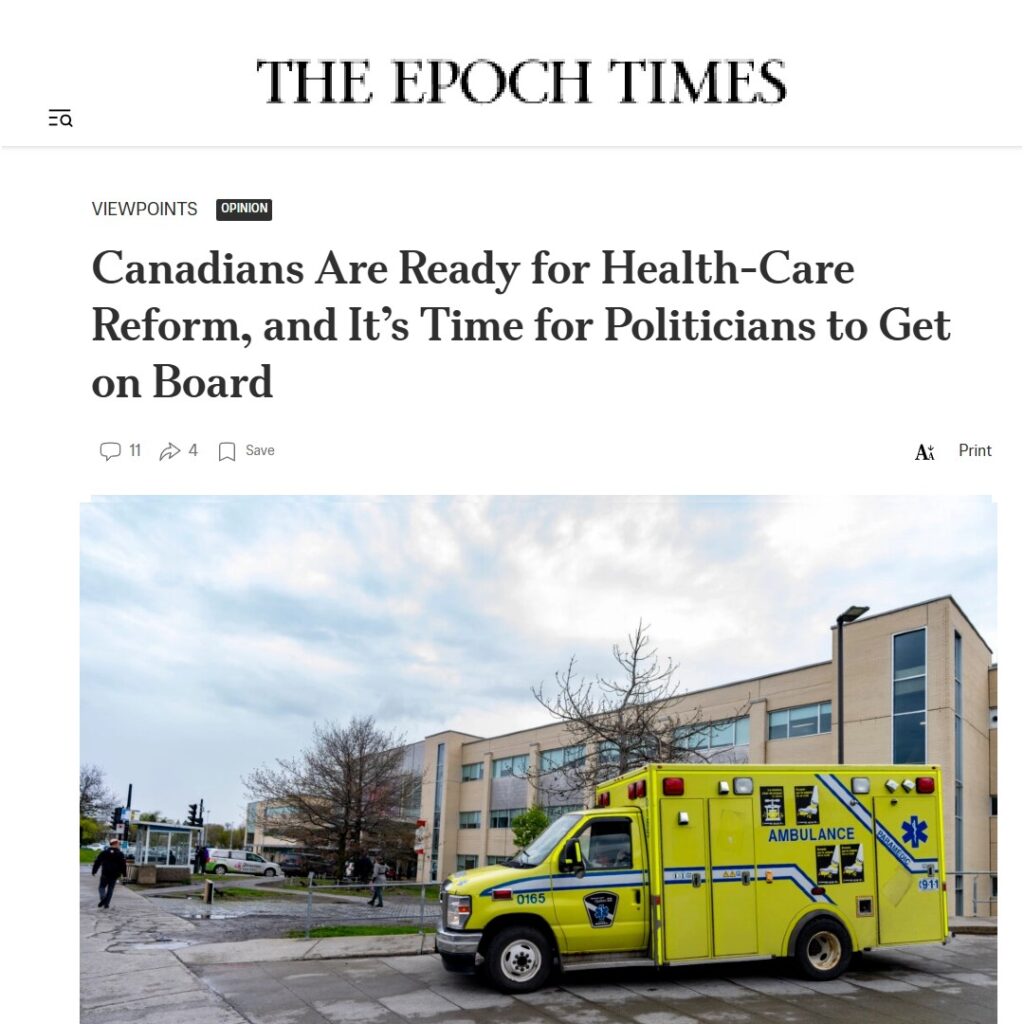
EPOCH TIMES COLUMN: Danielle Smith (finally) delivers health care reform
Health-care reform is often considered the “third rail” of Canadian politics—a reference to an electrified line on train tracks best left untouched. However, a new survey suggests that the Canadian public is ready for reform, and it’s time for politicians to get on board.
Provincial health-care systems are in crisis. We have a persistent shortage of physicians, nurses who are fed up with working conditions, and ERs that face routine closure. The Fraser Institute reports median wait times for elective surgery hit an all-time high (30 weeks) last year, and freedom of information by SecondStreet.org revealed at least 15,000 patients died on waitlists in 2024.
It doesn’t have to be this way. The experiences of more successful universal health-care systems provide us with proven strategies to improve our system—and Canadians seem generally supportive.
SecondStreet.org and Leger polled Canadians on five policies that help better-performing health systems—such as Sweden, Switzerland, the Netherlands, France, Australia, Germany, and Japan—and the following is what Leger found.
Almost six in 10 Canadians (59 percent) support private partnerships—i.e., the government paying non-government clinics to provide services to reduce wait times for patients in the public system. This type of collaboration is already prevalent in provinces like B.C., Alberta, and Quebec, and was also a notable part of the Saskatchewan Surgical Initiative, which saw a 75 percent reduction the in the number of patients waiting more than three months (2010–14).
There was identical support for the idea of keeping the public system but allowing people to pay for private treatment if they cannot get timely care within the public system. This move would help take pressure off the public system, allowing it to focus on helping patients who don’t have the funds to pay for private treatment.
The highest level of support for both of these policies was in Quebec, where the almost one-in-five publicly funded day surgeries are performed in private surgical centres. The Supreme Court of Canada has already ruled that the provincial ban on private insurance for core health-care services was against the Quebec Charter of Rights.
But health-care reform goes beyond issues pertaining to the role of the private sector.
For example, the majority of respondents also support changing the way hospitals are paid. Most provinces currently fund hospitals based on “global budgets”—governments send an annual cheque at the beginning of the year that treats patients like costs eating into funds. By contrast, the vast majority of universal health-care systems have shifted towards paying hospitals according to the volume and complexity of care provided—e.g., providing, say, $15,000 each time a provider does a knee operation (with adjustments for medical factors). Fifty-six percent of respondents agreed that hospitals should be paid using this more modern approach to funding.
This also depoliticizes the entire public private debate with money simply following patients to where care is delivered.
Canadians are, however, still reluctant to introduce user-fees in our system, with only about 30 percent supporting a small fee when people use the system. This is unsurprising in light of the recent concerns with the cost of living. However, cost-sharing (with protections for vulnerable populations) is a core feature of most universal health-care systems around the world, including primarily tax-based ones like Australia, Sweden, and France.
Finally, respondents were asked about the opposite: financial incentives for patients who live healthy lives. Discussions about health-care reform in Canada primarily revolve around the supply of health-care services with little consideration for reducing demand for potentially preventable conditions. Meanwhile, organizations like the Chronic Disease Prevention Alliance of Canada estimate the cost of treating diet-related disease in Canada was approximately $26 billion in 2015. Respondents seem to intuitively understand this connection, with about half (50 percent) believing governments should offer financial incentives to reward those who live healthy lives. Understandably, seniors aged 55 and older were most likely to oppose government-provided health incentives.
With a health-care system that continues to lurch towards disaster, Canadians understand the importance of enacting reform grounded in the experiences of more successful universal health-care countries around the world. Unfortunately, it’s patients who have to pay the price for political inertia.
Bacchus Barua is the research director at SecondStreet.org, a Canadian think tank.
This column was originally published in The Epoch Times on December 3, 2025.
This column was originally published in The Epoch Times on December 3, 2025.
Share on Facebook
Share on Twitter
You can help us continue to research and tell stories about this issue by making a donation or sharing this content with your friends. Be sure to sign up for our updates too!