

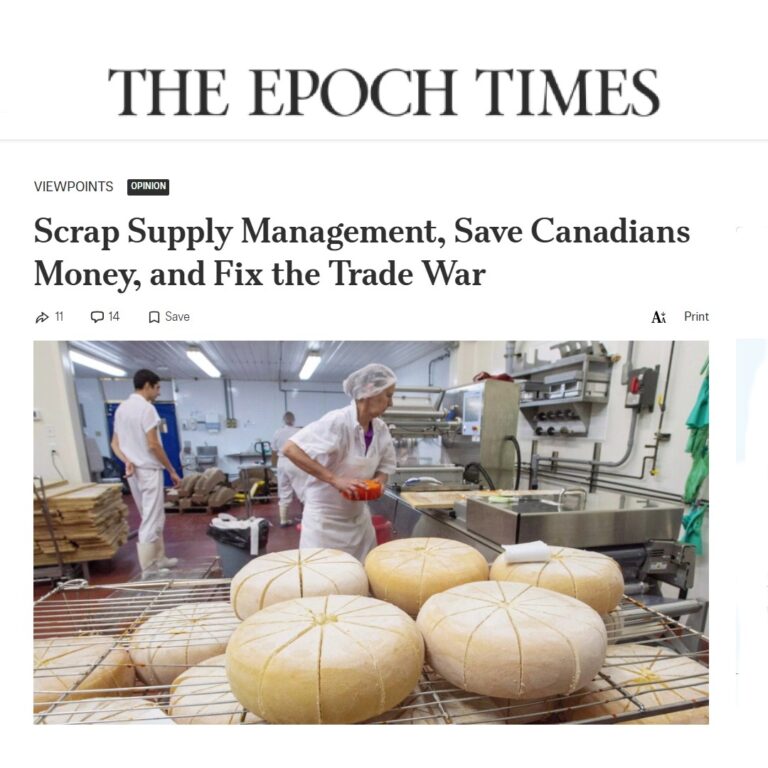


EPOCH TIMES COLUMN: Scrap Supply Management, Save Canadians Money, and Fix the Trade War

Supply management. It’s the sacred cow of Canadian politics—the federal government’s price-fixing scheme that costs everyday Canadians hundreds of dollars each year, enrages the United States, and is paid reverence by all four of the major federal political parties.

But as an unpredictable trade war is waged between Canada and our more powerful neighbour to the south, it’s time to seriously think about scrapping the cartel that controls prices on dairy, eggs, and poultry.

First, a quick primer.

In Canada, dairy (and poultry and egg) farms are tightly regulated. They’re only allowed to produce as much product as the government says so, using a system of “quota.” If a farmer gets more milk than is allowed by his quota, the excess must be dumped. You can go on YouTube and watch videos of farmers dumping perfectly good milk down the drain because they’re not allowed to sell it. At the same time, farmers who don’t own quota are banned from even selling dairy. To top it off, the government sets the prices for milk, cheese, etc.

Is this a free market economy, or Soviet Russia? In this sector, it’s much closer to the latter. An Alberta egg farmer has been arrested, and Greek Orthodox nuns in Quebec have been threatened with ludicrous fines for the horrendous crime of trying to sell food.

Don’t step out of line, comrades.

The end result of not having a competitive market is that it costs Canadians more for milk, dairy products, chicken, and turkey. Research by SecondStreet.org found that supply management results in Canadian consumers paying 29 percent more than their American counterparts for milk. Isn’t life expensive enough as it is?

Of course, the entire system would collapse if foreign competitors were allowed to enter the market. That’s why Canada levels tariffs of 241 percent on U.S. milk imports, effectively stopping American milk from being sold north of the border.

Understandably, this tends to tick off the United States.

While the trade situation has fluctuated greatly since President Donald Trump decided to target Canadian goods in March, the result has been clear: Life has, yet again, gotten more expensive for Canadians. Food inflation is one clear example.

And yet Prime Minister Mark Carney refuses to use a very powerful tool to help smooth over these trade negotiations and lower the tariffs on Canadian goods—drop supply management.

“With respect to supply management, I have been clear from the very first day of the launch of my leadership campaign. We will never have discussions with respect to supply management, it’s off the table.”

Why is this? Phasing out the policy would certainly help Canadian families save money, but would also help in trade negotiations with the United States.

Keeping the cartel is justified by all major federal political parties for one reason: It satisfies the farmers unjustly enriched by the quota system. The average net worth of a Canadian dairy farm is just over $6 million; it’s not so hard to do well when competition is banned and the government sets prices.

The solution is a simple one. Carney could hop on the phone and tell Trump that the Canadian government will immediately begin the process of phasing out the dairy (and egg, and poultry) cartel. First, by eliminating quotas and price-setting in Canada, allowing a true market to emerge. Second, tariffs on U.S. products could be eliminated over a five-year period.

It’s not impossible. In fact, it’s been done before in a country that’s similar to Canada in many ways. Australia used to have a similar regime, but it saw the writing on the wall and gradually phased out supply management. To placate the irritated dairy farmers, that country implemented a temporary 11-cents-per-litre tax on milk, the proceeds of which went to the farmers to “adjust to deregulation by consolidating, changing practices, or exiting the industry.” Even with this tax, the price of milk dropped immediately, and the tax was eventually removed as well.

It should be clear as day that Australia got it right, and the stakes were considerably lower for them at the time. They didn’t have the largest economy in the world on their border, levelling gigantic tariffs at them. Yet they still made a choice that annoyed a few for the good of the entire nation.

That’s the kind of leadership Carney could show. Dropping the dairy cartel might ruffle some feathers (or get a chorus of annoyed “moos”), but it’s the right thing to do.

Dom Lucyk is the Communications Director for SecondStreet.org, a Canadian think tank. 

This column was originally published in The Epoch Times on September 11, 2025.

Share on Facebook
Share on Twitter

You can help us continue to research and tell stories about this issue by making a donation or sharing this content with your friends. Be sure to sign up for our updates too!


Prevention – reduce demand in the first place

If Canadians lived healthier lives, we could reduce demand for emergency services, orthopaedic surgeries, primary care and more. 

For instance, if you visit the Canadian Cancer Society’s website, you’ll read that “about four in ten” cancer cases are preventable. The Heart and Stroke Foundation notes that “almost 80 percent of premature heart disease and stroke can be prevented through healthy behaviours.” A similar number of Diabetes cases are also preventable. 

Many joint replacements and visits to ERs and walk-in clinics could also be avoided through healthy living. 

To be sure, not all health problems can be avoided through healthy living – everyday the system treats Canadians with genetic conditions, helps those injured in unavoidable accidents and more.  

But there is an opportunity to reduce pressure on the health care system through Canadians shifting to healthier lifestyles – better diets, more exercise, etc. 

To learn more, watch our Health Reform Now documentary (scroll up) or see this column. 

Partner with non-profits and for-profit clinics

European countries will partner with anyone who can help patients. 

It doesn’t matter if it’s a non-profit, a government entity or a private clinic. What matters is that patients receive quality treatment, in a timely manner and for a competitive price.  

In Canada, governments often delivery services using government-run hospitals instead of seeing if non-profit or private clinics could deliver the services more effectively. 

When governments have partnered with non-profit and private clinics, the results have often been quite good – Saskatchewan, Ontario and British Columbia are just a few examples of where partnerships have worked well. 

Canada should pursue more of these partnerships to reduce wait times and increase the volume of services provided to patients.  

To learn more, watch our Health Reform Now documentary (scroll up) or see the links above. 

Make cross border care more accessible

In Canada, citizens pay high taxes each year and we’re promised universal health care services in return. The problem is, wait times are often extremely long in our health system – sometimes patients have to wait years to see a specialist or receive surgery. 

If patients don’t want to wait long periods, they often have to reach into their own pocket and pay for treatment outside the province or country. 

Throughout the European Union, we also find universal health care systems. But a key difference is that EU patients have the right to go to other EU countries, pay for surgery and then be reimbursed by their home government. Reimbursements cover up to what the patient’s home government would have spent to provide the treatment locally. 

If Canada copied this approach, a patient waiting a year to get their hip operation could instead receive treatment next week in one of thousands of surgical clinics throughout the developed world. 

Governments benefit too as the patient is now back on their feet and avoiding complications that sometimes come with long wait times – meaning the government doesn’t have to treat those complications on top of the initial health problem. 

To learn more, watch our Health Reform Now documentary (scroll up) or this shorter video. 

Legalize access to non-government providers

Canada is the only country in the world that puts up barriers, or outright bans patients from paying for health services locally. 

For instance, a patient in Toronto cannot pay for a hip operation at a private clinic in Toronto. Their only option is to wait for the government to eventually provide treatment or leave the province and pay elsewhere. 

Countries with better-performing universal health care systems do not have such bans. They allow patients a choice – use the public system or pay privately for treatment. Sweden, France, Australia and more – they all allow choice. 

Why? One reason is that allowing choice means some patients will decide to pay privately. This takes pressure off the public system. For instance, in Sweden, 87% of patients use the public system, but 13% purchase private health insurance. 

Ultimately, more choice improves access for patients. 

To learn more, watch our Health Reform Now documentary (scroll up) or watch this short clip on this topic. 

Shift to funding services for patients, not bureaucracies

In Canada, most hospitals receive a cheque from the government each year and are then asked to do their best to help patients. This approach is known as “block funding”. 

Under this model, a patient walking in the door represents a drain on the hospital’s budget. Over the course of a year, hospital administrators have to make sure the budget stretches out so services are rationed. This is why you might have to wait until next year or the year after for a hip operation, knee operation, etc. 

In better-performing universal health systems, they take the opposite approach – hospitals receive money from the government each time they help a patient. If a hospital completes a knee operation, it might receive, say, $10,000. If it completes a knee operation on another patient, it receives another $10,000. 

This model incentivizes hospitals to help more patients – to help more patients with knee operations, cataract surgery, etc. This approach also incentivizes hospitals to spend money on expenses that help patients (e.g. more doctors, nurses, equipment, etc.) rather than using the money on expenses that don’t help patients (e.g. more admin staff). 

To learn more about this policy option, please watch our Health Reform Now documentary (scroll up) or see this post by MEI.