

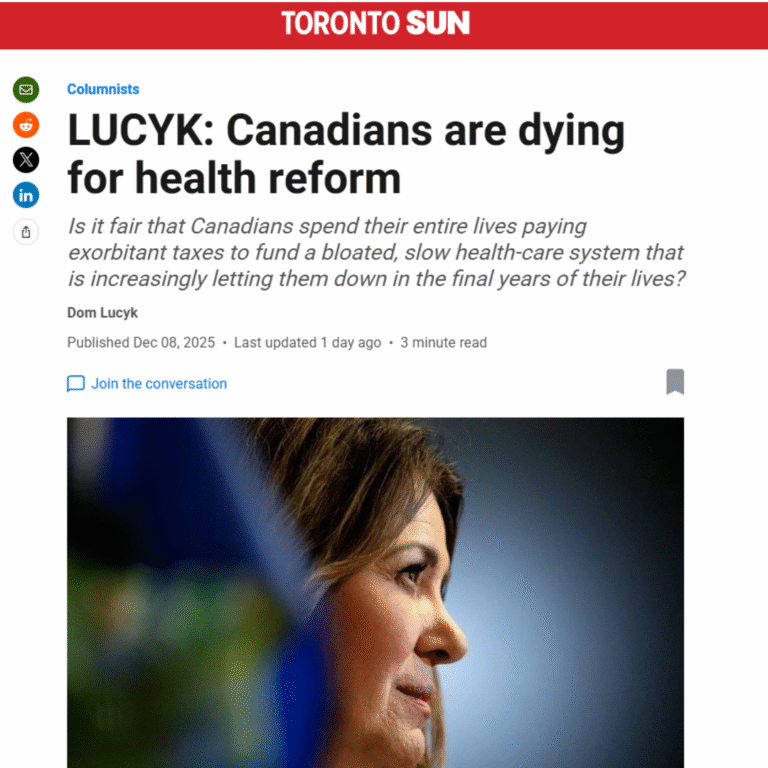


TORONTO SUN COLUMN: Canadians are Dying for Health Reform

Take the population of a small city you might have visited. Think of Kamloops in British Columbia, Lethbridge in Alberta or Niagara Falls in Ontario.

Now, imagine everyone in one of those cities being dead.
 
It’s not a pleasant image, but it puts the latest data on medical waitlist deaths from SecondStreet.org into perspective.
 
Since we started tracking this important metric of the government health-care system’s failures in 2018, over 100,000 patients have died waiting for various surgeries, procedures and diagnostic scans. Over the past fiscal year, there were more than 23,000 patient deaths alone.
 
And these are just the deaths we’ve confirmed through filing Freedom of Information requests nationwide — the true number is certainly much higher. Considering that most provinces don’t track how many patients are dying while waiting to meet with a specialist, Alberta used to give us data, but doesn’t anymore, and data from Manitoba doesn’t include diagnostic waitlist deaths.

So, the question is this: Is it fair that Canadians spend their entire lives paying exorbitant taxes to fund a bloated, slow health-care system that is increasingly letting them down in the final years of their lives?
 
Absolutely not. Canadians deserve urgent changes to improve the public system and increase the options available to patients.
 
Thankfully, one bold province is starting to take those steps.

Changes have yet to be implemented in Alberta

Alberta Premier Danielle Smith announced two big changes this year, though they’ve yet to be implemented.
 
First, the province will adopt activity-based funding. This is simply a better way to fund the health-care system. Instead of giving hospitals a big cheque each year and hoping they help a lot of patients, activity-based funding models see governments provide funding to hospitals each time they actually help a patient. For example, a hospital might receive $20,000 if it completes a knee operation or $300 if it helps a patient with a broken bone. This model incentivizes the hospital to help more patients and also leads to hospitals spending the funds they receive on expenses that help patients – doctors and nurses – rather than administrative staff.

Second, and even more boldly, Alberta will keep the public system, but remove barriers that prevent patients from being able to pay for care if they want to in their own province. This is an important change as allowing more choice for patients will take pressure off the public system each time a patient pays for health care at non-government facilities.
 
To be sure, activists and university professors might shake their fists over this change, demanding the government maintain a monopoly, but they can rest assured. If they shake too hard and injure their hands, they’ll at least have better access to care.

Changes will help the system be comparable to others

These two big changes will make Alberta’s health-care system a lot more like systems from Europe, Australia, Japan and elsewhere. These countries all have universal health-care systems that perform much better than Canada’s. They tend not to see the kind of massive waits and waitlist deaths that we do.
 
So, for her bold changes to the system, Smith should be applauded. If her government implements the changes properly, we should see a noticeable jump in the quality and accessibility of care in Alberta. When that happens, other provinces will be hard-pressed not to follow suit.
 
Something needs to be changed. Canadians are, in the most literal sense of the word, dying for lack of health reform. It can’t go on for much longer.
Dom Lucyk is the communications director for SecondStreet.org, a Canadian think tank

This column was originally published in the Sun newspapers on December 8, 2025.
Share on Facebook
Share on Twitter

You can help us continue to research and tell stories about this issue by making a donation or sharing this content with your friends. Be sure to sign up for our updates too!


Prevention – reduce demand in the first place

If Canadians lived healthier lives, we could reduce demand for emergency services, orthopaedic surgeries, primary care and more. 

For instance, if you visit the Canadian Cancer Society’s website, you’ll read that “about four in ten” cancer cases are preventable. The Heart and Stroke Foundation notes that “almost 80 percent of premature heart disease and stroke can be prevented through healthy behaviours.” A similar number of Diabetes cases are also preventable. 

Many joint replacements and visits to ERs and walk-in clinics could also be avoided through healthy living. 

To be sure, not all health problems can be avoided through healthy living – everyday the system treats Canadians with genetic conditions, helps those injured in unavoidable accidents and more.  

But there is an opportunity to reduce pressure on the health care system through Canadians shifting to healthier lifestyles – better diets, more exercise, etc. 

To learn more, watch our Health Reform Now documentary (scroll up) or see this column. 

Partner with non-profits and for-profit clinics

European countries will partner with anyone who can help patients. 

It doesn’t matter if it’s a non-profit, a government entity or a private clinic. What matters is that patients receive quality treatment, in a timely manner and for a competitive price.  

In Canada, governments often delivery services using government-run hospitals instead of seeing if non-profit or private clinics could deliver the services more effectively. 

When governments have partnered with non-profit and private clinics, the results have often been quite good – Saskatchewan, Ontario and British Columbia are just a few examples of where partnerships have worked well. 

Canada should pursue more of these partnerships to reduce wait times and increase the volume of services provided to patients.  

To learn more, watch our Health Reform Now documentary (scroll up) or see the links above. 

Make cross border care more accessible

In Canada, citizens pay high taxes each year and we’re promised universal health care services in return. The problem is, wait times are often extremely long in our health system – sometimes patients have to wait years to see a specialist or receive surgery. 

If patients don’t want to wait long periods, they often have to reach into their own pocket and pay for treatment outside the province or country. 

Throughout the European Union, we also find universal health care systems. But a key difference is that EU patients have the right to go to other EU countries, pay for surgery and then be reimbursed by their home government. Reimbursements cover up to what the patient’s home government would have spent to provide the treatment locally. 

If Canada copied this approach, a patient waiting a year to get their hip operation could instead receive treatment next week in one of thousands of surgical clinics throughout the developed world. 

Governments benefit too as the patient is now back on their feet and avoiding complications that sometimes come with long wait times – meaning the government doesn’t have to treat those complications on top of the initial health problem. 

To learn more, watch our Health Reform Now documentary (scroll up) or this shorter video. 

Legalize access to non-government providers

Canada is the only country in the world that puts up barriers, or outright bans patients from paying for health services locally. 

For instance, a patient in Toronto cannot pay for a hip operation at a private clinic in Toronto. Their only option is to wait for the government to eventually provide treatment or leave the province and pay elsewhere. 

Countries with better-performing universal health care systems do not have such bans. They allow patients a choice – use the public system or pay privately for treatment. Sweden, France, Australia and more – they all allow choice. 

Why? One reason is that allowing choice means some patients will decide to pay privately. This takes pressure off the public system. For instance, in Sweden, 87% of patients use the public system, but 13% purchase private health insurance. 

Ultimately, more choice improves access for patients. 

To learn more, watch our Health Reform Now documentary (scroll up) or watch this short clip on this topic. 

Shift to funding services for patients, not bureaucracies

In Canada, most hospitals receive a cheque from the government each year and are then asked to do their best to help patients. This approach is known as “block funding”. 

Under this model, a patient walking in the door represents a drain on the hospital’s budget. Over the course of a year, hospital administrators have to make sure the budget stretches out so services are rationed. This is why you might have to wait until next year or the year after for a hip operation, knee operation, etc. 

In better-performing universal health systems, they take the opposite approach – hospitals receive money from the government each time they help a patient. If a hospital completes a knee operation, it might receive, say, $10,000. If it completes a knee operation on another patient, it receives another $10,000. 

This model incentivizes hospitals to help more patients – to help more patients with knee operations, cataract surgery, etc. This approach also incentivizes hospitals to spend money on expenses that help patients (e.g. more doctors, nurses, equipment, etc.) rather than using the money on expenses that don’t help patients (e.g. more admin staff). 

To learn more about this policy option, please watch our Health Reform Now documentary (scroll up) or see this post by MEI.