

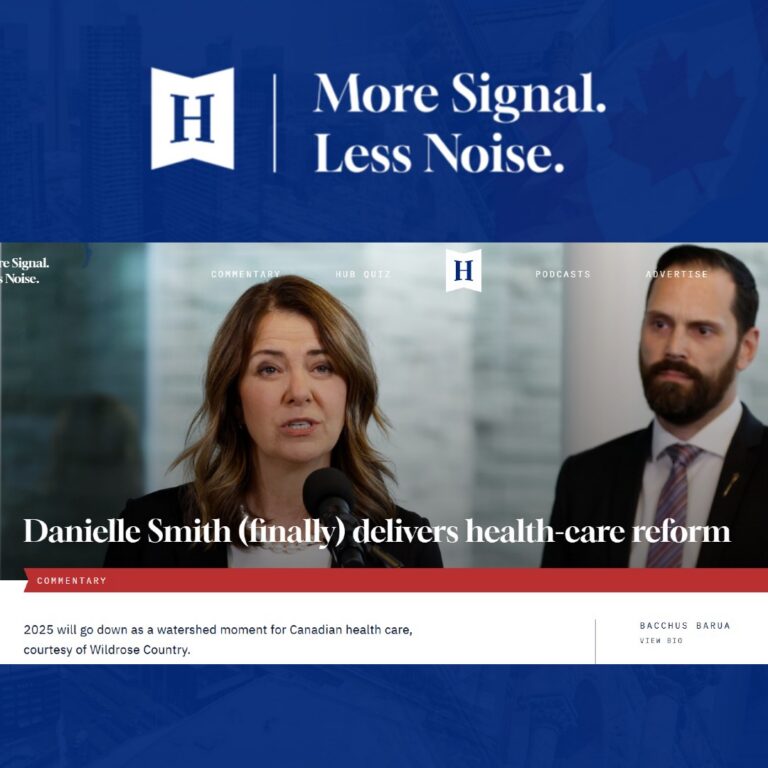


2025 will go down as a watershed moment for Canadian health care, courtesy of Wildrose Country.
The combination of reforms announced by the Smith government this year represents a bold reclamation of provincial jurisdiction while respecting the federal Canada Health Act (CHA). From changing the way the Alberta government pays hospitals, to allowing patients to directly purchase diagnostic scans and testing, Smith is pushing the boundaries without breaking them.
However, the government’s most recent salvo—legislation allowing physicians to “toggle” between public and private practice—has stirred up a proverbial hornet’s nest of controversy. Simply put, Smith proposes to keep the public system but make it easier for patients to pay at private clinics for things like hip and knee operations if they would like. What critics fail to understand is that not only will these reforms fundamentally improve patients’ lives, but they may actually save the public system from imploding.
It’s important to understand how we got here. According to the Fraser Institute, Albertans faced a 38-week wait for scheduled treatment last year—two months longer than the national average, itself a 30-year high. At the same time, government data released by the Montreal Economic Institute revealed almost one-in-10 patients left the emergency room untreated in 2024, while SecondStreet.org documented over half a million patients waiting for treatment in the province this year. Clearly, our public health-care system is failing its patients.
Unfortunately, the current system means patients are generally stuck on these wait lists with few alternatives that don’t involve hopping on a plane and crossing borders.
Enter Bill 11—legislation that (among other things) fundamentally expands physician freedom and gives patients a meaningful alternative to the confines of the ailing public system.
Until recently, provincial legislation forced physicians to choose between practicing in the public or private system; they could not do both. Surgeons who opted out could no longer treat patients in a public hospital and bill the government. Meanwhile, those who remained in the public system could find themselves resigned to playing a round of golf because they couldn’t get operating room time while willing patients waited. Neither situation made any sense for patients or providers.
Worse, this binary approach actually risks creating exactly the sort of two-tier system proponents of Medicare fear—driving physicians to opt out entirely if frustrations with the public system persist. Just take a look at Quebec, where increasingly restrictive legislation by the provincial government has turned a trickle of opted-out physicians into an exodus (Quebec may have a more permissive private sector, but it does not allow dual practice).
That’s exactly what Bill 11 fixes; it allows physicians in Alberta to toggle between the two systems—serving the public patients as before, but with the added freedom to treat private-pay patients in their remaining time.
This is what other high-performing countries with universal health-care systems allow. Australia, France, Germany, Denmark, Japan, the Netherlands, and the United Kingdom all understand that allowing mixed practice for physicians is a fundamental component of a well-functioning universal health-care system.
Of course, they also employ guardrails: minimum hours in public hospitals, caps on private revenue, contractual obligations. The result is that dual-practice physicians often work more total hours across the public and private sectors than their counterparts who work exclusively in public hospitals. Simply put, more patients get the treatment they need.
It looks like the Smith government has done its homework and will proactively implement similar guardrails, while also prohibiting dual practice in critical care fields.
But the litmus test of these reforms will not be whether those able to purchase private care benefited, but whether those who remain dependent on the public list see improved access. Simply put, compassionate Canadians will ask whether these reforms ultimately improved, or worsened, the lives of every patient—or simply the rich.
To that end, the Smith government must invest significant effort in improving the public system. This can be done by:
- Creating a central intake process to pool referrals and connect patients more efficiently with physicians. This policy was a key part of the Saskatchewan Surgical Initiative and automatically connects patients to physicians with the shortest wait.
- Fast-tracking previously announced reforms to fund hospitals based on output, incentivizing them to treat more patients while improving efficiency. Moving away from the current approach of global budgeting will improve transparency and ensure that money follows patients to where it is needed most.
- Allocating more health-care dollars per person to match the increased volume of care that inevitably follows the implementation of activity-based funding. As someone who has often criticized governments for simply throwing money at health-care problems, I say this with careful consideration. Although activity-based funding (ABF) will lead to a more efficient system, actually making a dent in existing backlogs will mean the government will have to spend more—even if some patients opt to pay privately. While the Smith government could mitigate this by capping total expenditures, doing so would restrict the true potential of ABF. Empirical evidence shows countries that have implemented ABF have lower procedure costs, but may result in high overall costs simply because of the greater volume of care delivered. Spending is not necessarily a problem if the government’s books are balanced, and the money actually translates into care. At least in the short-term, it would be wise for governments to budget for increased expenditures to reduce the backlogs created by inaction over the years.
Dual practice is a common sense approach employed by several of our international peers. Done right, it offers physicians the freedom to maximize their productivity, gives patients a viable alternative to clinically unreasonable waits, and can improve timely access to care within the public system by reducing patient backlog. Pairing this reform with changes to hospital funding and centralized patient referrals is a recipe for success.
Ultimately, Premier’ Smith’s legacy will depend on improving access to care for all Albertans—not just those who will directly benefit from this bill.
Bacchus Barua is Research Director for SecondStreet.org.
This column was originally published in The Hub on December 3, 2025.
Share on Facebook Share on TwitterYou can help us continue to research and tell stories about this issue by making a donation or sharing this content with your friends. Be sure to sign up for our updates too!